Showing posts with label coast. Show all posts

Tuesday, 17 July 2018

How to read water - The Packing Shed

Yesterday I went to a different part of the coast and decided this was a good opportunity to learn more about how to read water. Essex has some beautiful islands and interesting history, and I have wanted to visit The Packing Shed for a long time. The building sits on a small spit off the coast of Mersea Island. It was built for the packing of oysters, a traditional fishing trade in Essex since Roman times. There are five open days a year so I took the opportunity and visited with a friend. The only access is by boat....


When we arrived it was approaching high tide and you could see the beds that were used to filter the oysters before cleaning and packing. 


Inside the Packing Shed there is a small collection from its working days. These wooden boards were worn on your feet to stop you sinking into the deep mud that surrounds the island. 


Our visit included a cream tea. What an amazing view! And as we sat there we watched the tide go out. Soon the filter beds were covered.


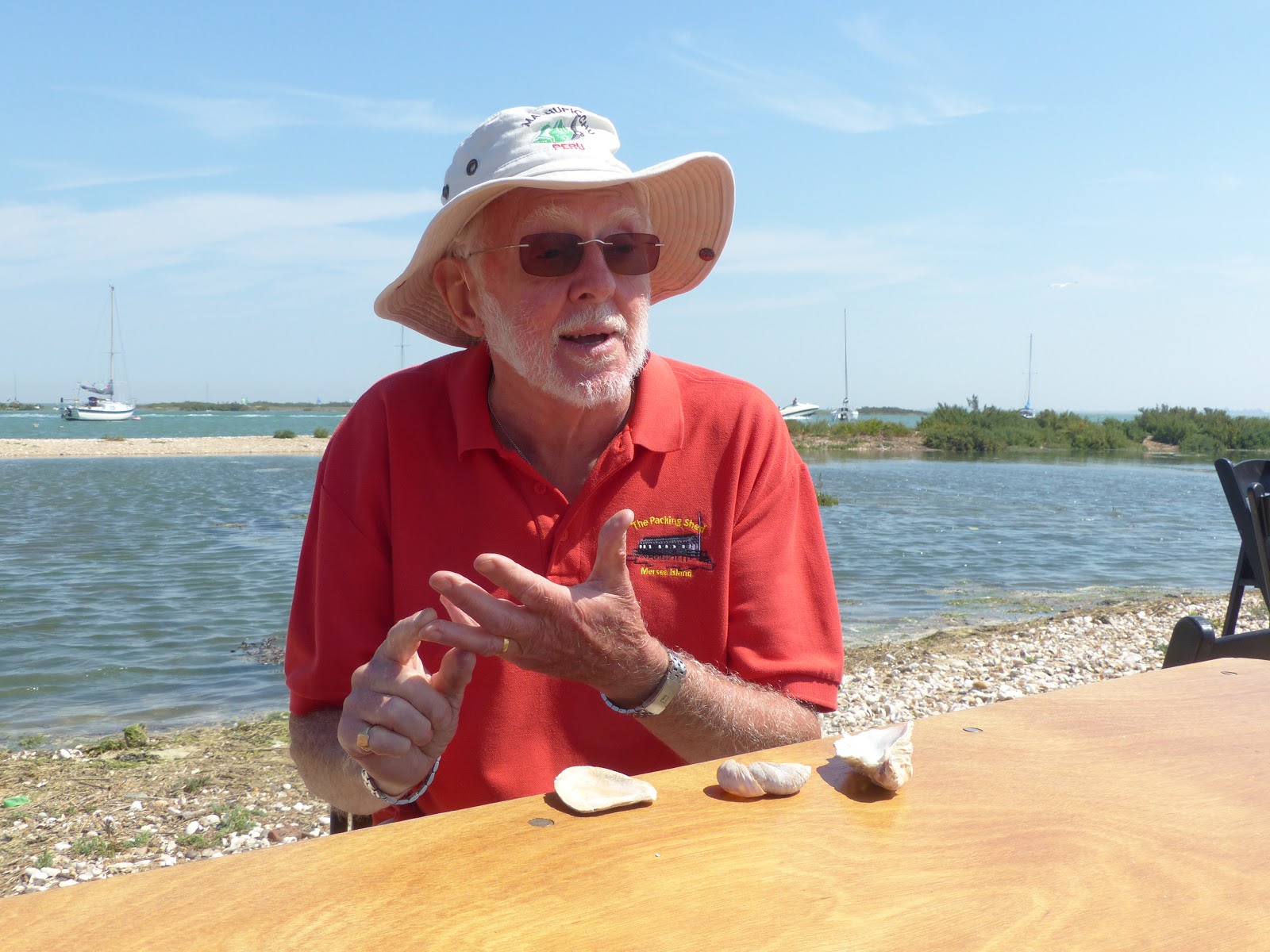
This gentleman joined us at the table and told us about the history of The Packing Shed. He bought examples of oyster shells and told how the local oysters were devastated by disease on several occasions. The last survivors were sadly lost in the 1963 winter when this area of the coast froze over. Stocks were replenished from other sources and they have gradually re-established. Meantime it was suggested that oysters from Portugal was also introduced. These are a much larger variety and fairly resistant to disease, and so far stocks are doing well and traditional oyster fishing continues. We also learnt that the 'slipper limpet' was bought into local waters by US ships during WWII. Because these encrusted the bottom of the ship and slowed them down, they dragged them off using chains. The limpets have since grown in huge numbers, and frequently seen around the coast.  

Meanwhile the tide continued to go out, and the spit got smaller and smaller.


We could still walk around the last narrow stretch, being careful of the resident birds.


Maybe the time passed quickly because we enjoyed learning about the island and exploring, and it didn't seem long before we spotted the tell tale sign of the tide turning. We saw Samphire growing in abundance, a delicacy more seen in restaurants than in shops. 


The stretch of shingle stretched and stretched with the outgoing tide until we could walk right out. 


And once again island revealed the oyster filter beds, and The Packing Shed said goodbye to its visitors until next time. 


Something I learnt during my visit was the importance of this spit of land and the two small islands that lie next to it. Together these protect the main harbour and fishing grounds of East Mersea, reducing the silt and coastal erosion. I've read about this is the book 'How to Read Water' but it never occurred to me that these small islands so far from shore could have such an impact. So, granite and sea shells have been added to raise the height and stabilise The Packing Shed island, and more is planned in the near future. It was also interesting to learn that the shells come from local waters to maintain ecology, and that the granite is also carefully chosen too. It was a wonderful visit and the weather was just perfect with blue skies and a cooling breeze. I am already looking forward to my next visit!

This post is part of a project in an attempt to learn 'How to Read Water'. It includes daily observations and visits to local rivers over a 30 day period. You can read more about it here. 

Friday, 13 July 2018

How to read water - In 30 days

Recently I bought a new book as I want to have a better understanding of tides and currents. I have lots of local waterways  and I would love to explore them in my kayak; however, lack of knowledge and experience makes me wary. But this is a good thing isn't it - because it would be foolhardy to go out into tidal waters without some knowledge and preparation. 


I have learnt so much from just two chapters and I thoroughly recommend this book if this is a subject that interests you too. We hear so much about the moon's gravitational pull on the earth and how that creates tides. But did you know that the sun also has a gravitational pull. How have I lived all these years and not realised?! Suddenly, so many things have become clear and as well as learning a lot it is also an enjoyable book to read. 

And as I read the book this morning, I was suddenly had an idea for a project. So for the next month I plan to visit the river every day at about the same time.  Naturally life goes on and there will be days I miss, but I'm looking forward to getting involved and seeing what comes from this.

And to start, I have unwrapped a beautiful handmade book that a friend recently sent me. It has a sea chart cover and watercolour painted pages that representing water. It's just perfect! I will make notes of all the interesting facts and things I learn. I knew I would find a special use for this book!


The purpose of my river visits are to observe and connect with my experience. Because, we can miss so much when our thoughts distract us. These are the times when our mind can be in a different time or place, and so it is my intention to practice being present and to  awaken all my senses. 

Today I paid attention to:
  • The tide lines, as these mark the highest level of the water.
  • Flotsam - what gets left behind along the tide line.
  • Wind direction and speed - It was a light breeze today but it was interesting to notice that it blew in the opposite direction from the flow of tide. This was deceptive, as on first glance you'd be mistaken to think the tide was coming upstream, but the photo below shows otherwise. 
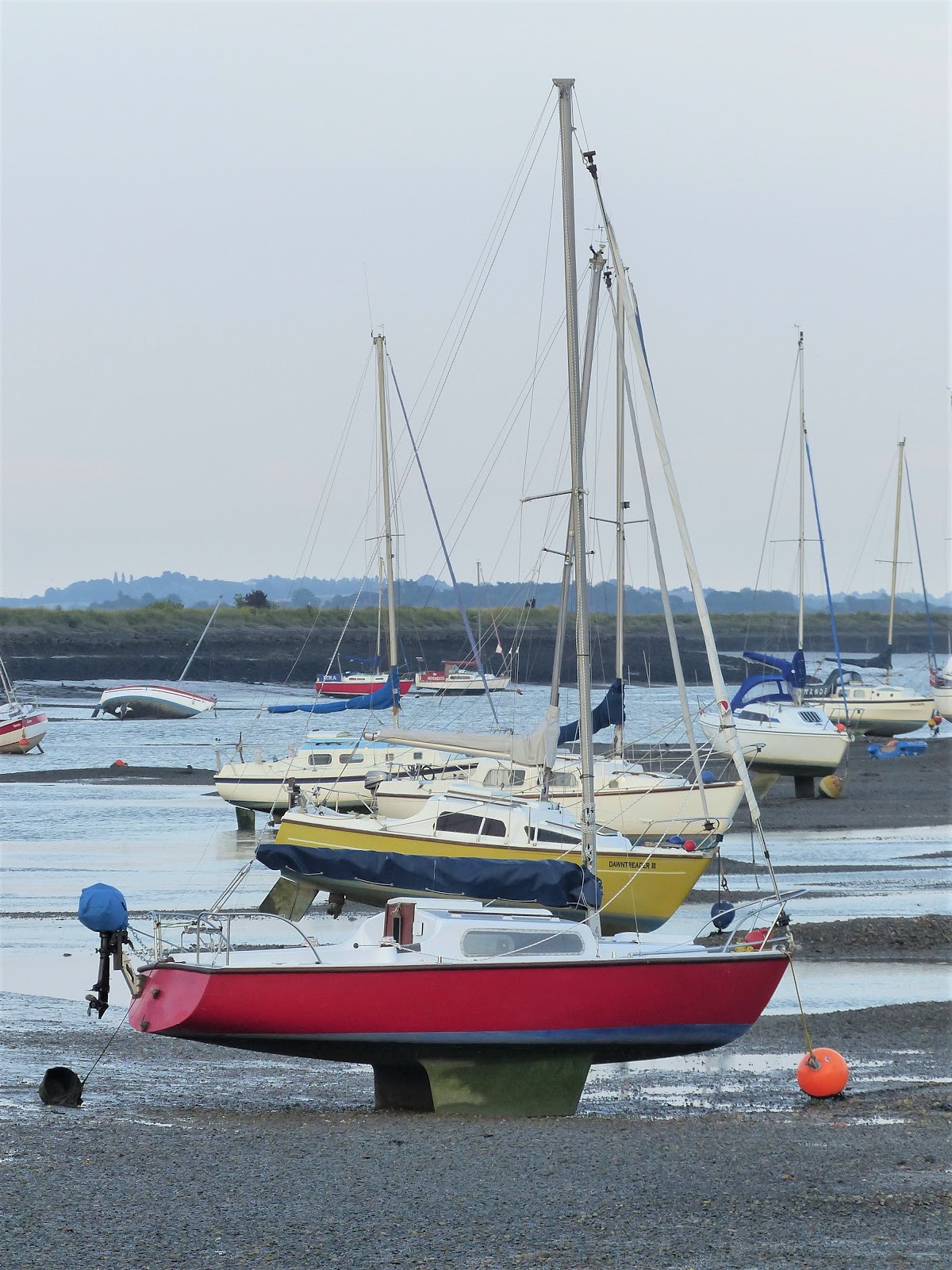
  • The flow of water - being mudflats and estuary this makes for interesting features. I was reminded in 'How to Read Water' that when water runs through narrow channels it becomes faster and more active. I saw this for myself, and could see the directional flow. The boats on their mooring can tell you this too, as their bow always points to where the water is coming from. But today they were stranded on the mud, the water a mere puddle around their keels.

  • The current tide - it happened to be at it's lowest at the time of my visit. Probably the lowest water I have ever observed, although that might be because I was paying proper attention today rather than just noticing it as low tide. I realised that if I had boots on I could probably wade across easily. Many years ago, before a school was built this side of the river, children used to have to cross to the other side to go to school. They'd be ferried across by boat at high tide, and come across in a horse and cart at low tide. What a fun way to go!
  • Relation to the sun and moon - today is a New Moon so I couldn't have chosen a better time to start my project. This is purely coincidental and not planned!
  • Plant and animal life in and along the edge of the river - I was lucky to see a pair of egrets, and as always, the large flock of resident swans came up the causeway to see if I had any food. For the first time, I became aware of the funny padding sound that their feet make on concrete, and how their feet are reptile-like in appearance. I always admire the swathes of sea lavender and the reeds blowing in the breeze. Today was no exception.


  • How the water makes channels and gradually changes course - I love this landscape and have always been fascinated by this, but today I was even more attentive. I looked for small hollows in the mudflat, and others that have grown deeper. And I saw how  eventually a new water course has cut through, or a mudflat is separated to form an island. I also paid attention to the stickiness of the mud. In places there was water still lying on the surface, or making a small channel. Most of the mudflats are covered with course grass and sea plants. But one was partly exposed, the surface cracked and crusty. Perhaps it was baked by todays sun, because I am certain it is covered by each incoming tide. I will have to look on future visits. 


I will use my photos as a record and I plan to make a book to keep them in. Today's photo collection numbered 200+ but that's because it was low tide and I could see all the different landscapes and features. My main focus will be to record the tide levels, and learn to read the water. Of course I won't be an expert in 30 days, but I should know a whole lot more than I do now!  
So I'll be back with more photos and progress soon. 
Thank you for visiting...  

Related Posts Plugin for WordPress, Blogger...