Sunday, 5 August 2018

5 in 5 - August 2018 - Mindfullness On The Go

Welcome to '5 in 5' where on the 5th of 
each month I post 5 photos that I have 
taken in 5 minutes.


I am not new to meditation and mindfulness but when this book was recommended by a friend I decided it had a place on my bookshelf. The author, Padraig O'Morain, lists ideas and ways of being mindful within our busy lives and that has got to be useful, hasn't it! As I considered what photos to take for this months 5in5 I saw this quote:
 
Let there be

an opening

into the quiet

that lies beneath

the chaos,

where you find

the peace

you did not think

possible

and see what shimmers

within the storm.


- Jan Richardson


And so this month I thought I would share some of the suggestions, and things that I have been doing:

Most of us look forward to our first drink of the day, but rather than drink this while you flick through the newspaper, social media, or think about all the things that you need to do - just take a couple of minutes to pause. Bring awareness to any aroma, the colour, and surface of your drink - for example, is it smooth, frothy, are there any bubbles, reflections or movement? How does the cup feel in your hand? Notice what you notice, and then as you take your first sip again bring attention to any sensations, taste, texture, and feelings. Just allow your mind to notice these, and if it wanders away just bring it gently back. Notice how much more you enjoy your drink when you are paying gentle attention.

When we eat we can sometimes get into bad habits. We might watch tv curled up on the sofa, or dash around eating a sandwich, and before we know it our plate is empty! It doesn't matter that we might have spent ages preparing and cooking a meal, or maybe choose something special, so pausing to enjoy time eating can give pleasure and be a more satisfying experience. So, similar with the drink, give attention to the food you are about to eat. Notice the colour, texture, and temperature; and if you eat a biscuit or piece of fruit, notice how it feels to hold it in your hand. Are there any sounds as you bite into it? Just give a few minutes to notice what you notice, and become more aware of the enjoyment of eating.

In our busy and distracted lives we can sometimes forget to listen  and instead, as someone speaks, we might be thinking of a response or something that we want to say.  So another mindfulness practice involves truly listening, and giving the other person our full attention. As well as making that person feel valued, it allows our busy minds a moment to pause and to be in the present, rather than jostling to be in the future.  


One of my favourite practices is to sit quietly and just to notice what sounds I hear. One way to increase this experience is to notice what you can hear in front, each side, from behind, above and below. Listen for different frequencies, as some sounds are more difficult for our human ear to pick up, and be prepared to be surprised. When I was at the river the other day the tide was out and I was surrounded by thick mud. But as I listened I could quietly hear the movement of water, even though there was no visible sign. 


Another practice I enjoy which you can do anywhere, is to be aware of your own presence.  Notice your breathing, the rhythm, or where the breath is coming from (chest or belly). If opportunity allows, sit quietly with your eyes closed; but you can still do this effectively with your eyes open if you are sitting in traffic or for an appointment which is running late. There is much evidence that mindfulness can create a calming influence, so much better than feeling irritated or anxious!  

Or do a body check: Start at your head and work down each part of your body, noticing what you notice without judgement or focus. If unwanted thoughts intrude, allow them to pass in a gentle way, and return to your practice.  

As well as using your body, you can also notice what ever is around. I enjoy watching clouds, reflections, or the way the wind blows through the leaves; but there are so many different ways of practicing mindfulness.  Living in the present moment has so many benefits, and it also enriches simple every day experiences and makes us more aware and in tune. For anyone interested, you can use mindfulness when taking photos and I wrote about this back in January 2017, in 'Adventures in Seeing'.

So, thank you for visiting!  If you would like to join in this month's challenge you have until 25th to take your photos and post a link to your blog. Here's how it works:

1.  Choose a location.

2.  Have your camera ready.

3.  Set a mobile timer for 5 minutes.

4.  Take as many photos you can until the time is up.
5.  Choose 5 photos to download and share by using the link tool (for this month only please go HERE to link)
   You have until the 25th of the month to add your photos and if
you want to know more about 5in5 there are details here.

And one more thing - when you use the link tool, please click on your post title.  This will show the web address. Please right click, copy and paste this as your link.  This will take readers directly to your '5 in 5' blog page and be easier for them to find.

Tuesday, 17 July 2018

How to read water - The Packing Shed

Yesterday I went to a different part of the coast and decided this was a good opportunity to learn more about how to read water. Essex has some beautiful islands and interesting history, and I have wanted to visit The Packing Shed for a long time. The building sits on a small spit off the coast of Mersea Island. It was built for the packing of oysters, a traditional fishing trade in Essex since Roman times. There are five open days a year so I took the opportunity and visited with a friend. The only access is by boat....


When we arrived it was approaching high tide and you could see the beds that were used to filter the oysters before cleaning and packing. 


Inside the Packing Shed there is a small collection from its working days. These wooden boards were worn on your feet to stop you sinking into the deep mud that surrounds the island. 


Our visit included a cream tea. What an amazing view! And as we sat there we watched the tide go out. Soon the filter beds were covered.


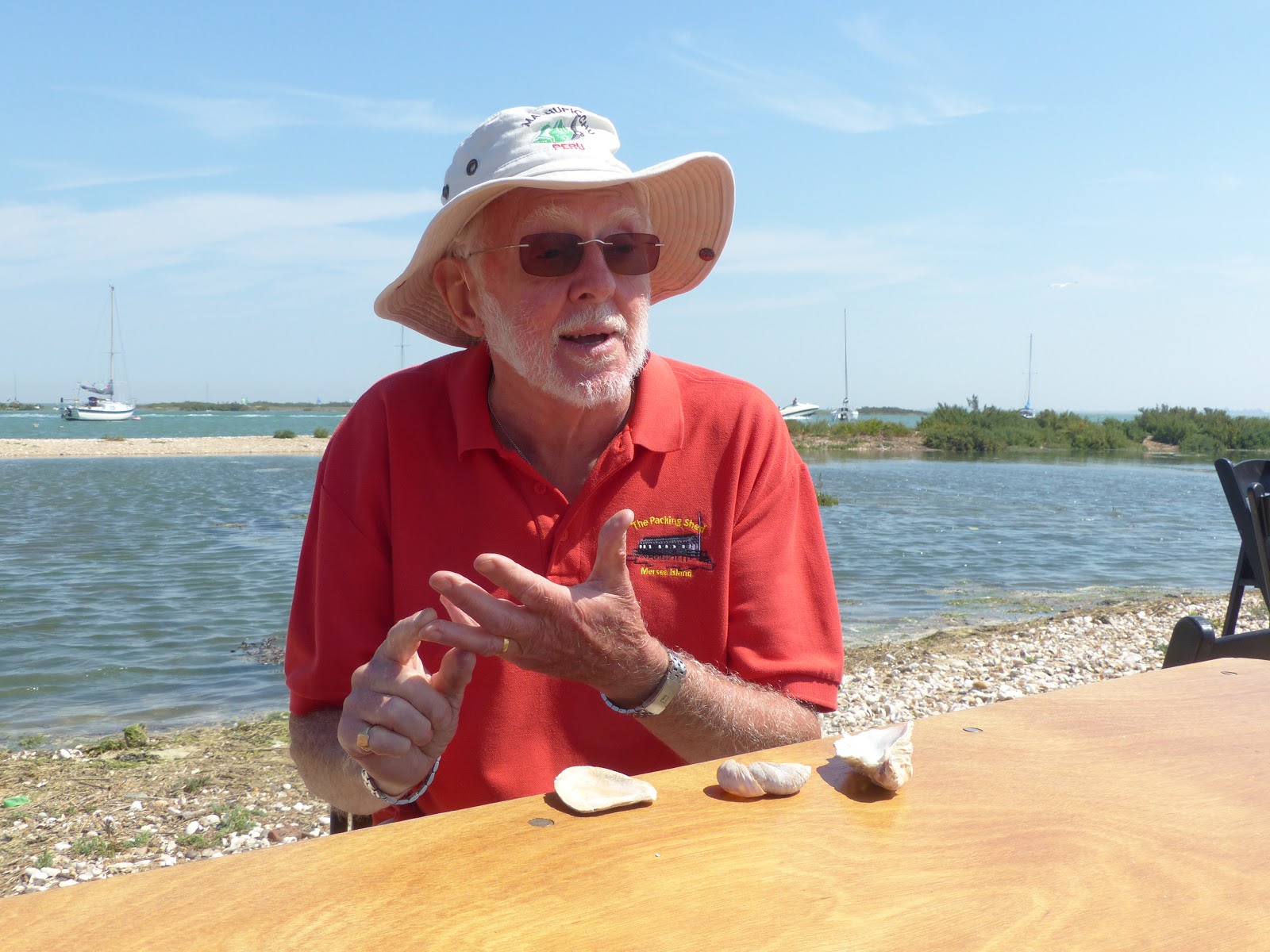
This gentleman joined us at the table and told us about the history of The Packing Shed. He bought examples of oyster shells and told how the local oysters were devastated by disease on several occasions. The last survivors were sadly lost in the 1963 winter when this area of the coast froze over. Stocks were replenished from other sources and they have gradually re-established. Meantime it was suggested that oysters from Portugal was also introduced. These are a much larger variety and fairly resistant to disease, and so far stocks are doing well and traditional oyster fishing continues. We also learnt that the 'slipper limpet' was bought into local waters by US ships during WWII. Because these encrusted the bottom of the ship and slowed them down, they dragged them off using chains. The limpets have since grown in huge numbers, and frequently seen around the coast.  


Meanwhile the tide continued to go out, and the spit got smaller and smaller.


We could still walk around the last narrow stretch, being careful of the resident birds.


Maybe the time passed quickly because we enjoyed learning about the island and exploring, and it didn't seem long before we spotted the tell tale sign of the tide turning. We saw Samphire growing in abundance, a delicacy more seen in restaurants than in shops. 


The stretch of shingle stretched and stretched with the outgoing tide until we could walk right out. 


And once again island revealed the oyster filter beds, and The Packing Shed said goodbye to its visitors until next time. 


Something I learnt during my visit was the importance of this spit of land and the two small islands that lie next to it. Together these protect the main harbour and fishing grounds of East Mersea, reducing the silt and coastal erosion. I've read about this is the book 'How to Read Water' but it never occurred to me that these small islands so far from shore could have such an impact. So, granite and sea shells have been added to raise the height and stabilise The Packing Shed island, and more is planned in the near future. It was also interesting to learn that the shells come from local waters to maintain ecology, and that the granite is also carefully chosen too. It was a wonderful visit and the weather was just perfect with blue skies and a cooling breeze. I am already looking forward to my next visit!

This post is part of a project in an attempt to learn 'How to Read Water'. It includes daily observations and visits to local rivers over a 30 day period. You can read more about it here. 
Related Posts Plugin for WordPress, Blogger...