Tuesday, 17 July 2018

How to read water - The Packing Shed

Yesterday I went to a different part of the coast and decided this was a good opportunity to learn more about how to read water. Essex has some beautiful islands and interesting history, and I have wanted to visit The Packing Shed for a long time. The building sits on a small spit off the coast of Mersea Island. It was built for the packing of oysters, a traditional fishing trade in Essex since Roman times. There are five open days a year so I took the opportunity and visited with a friend. The only access is by boat....


When we arrived it was approaching high tide and you could see the beds that were used to filter the oysters before cleaning and packing. 


Inside the Packing Shed there is a small collection from its working days. These wooden boards were worn on your feet to stop you sinking into the deep mud that surrounds the island. 


Our visit included a cream tea. What an amazing view! And as we sat there we watched the tide go out. Soon the filter beds were covered.


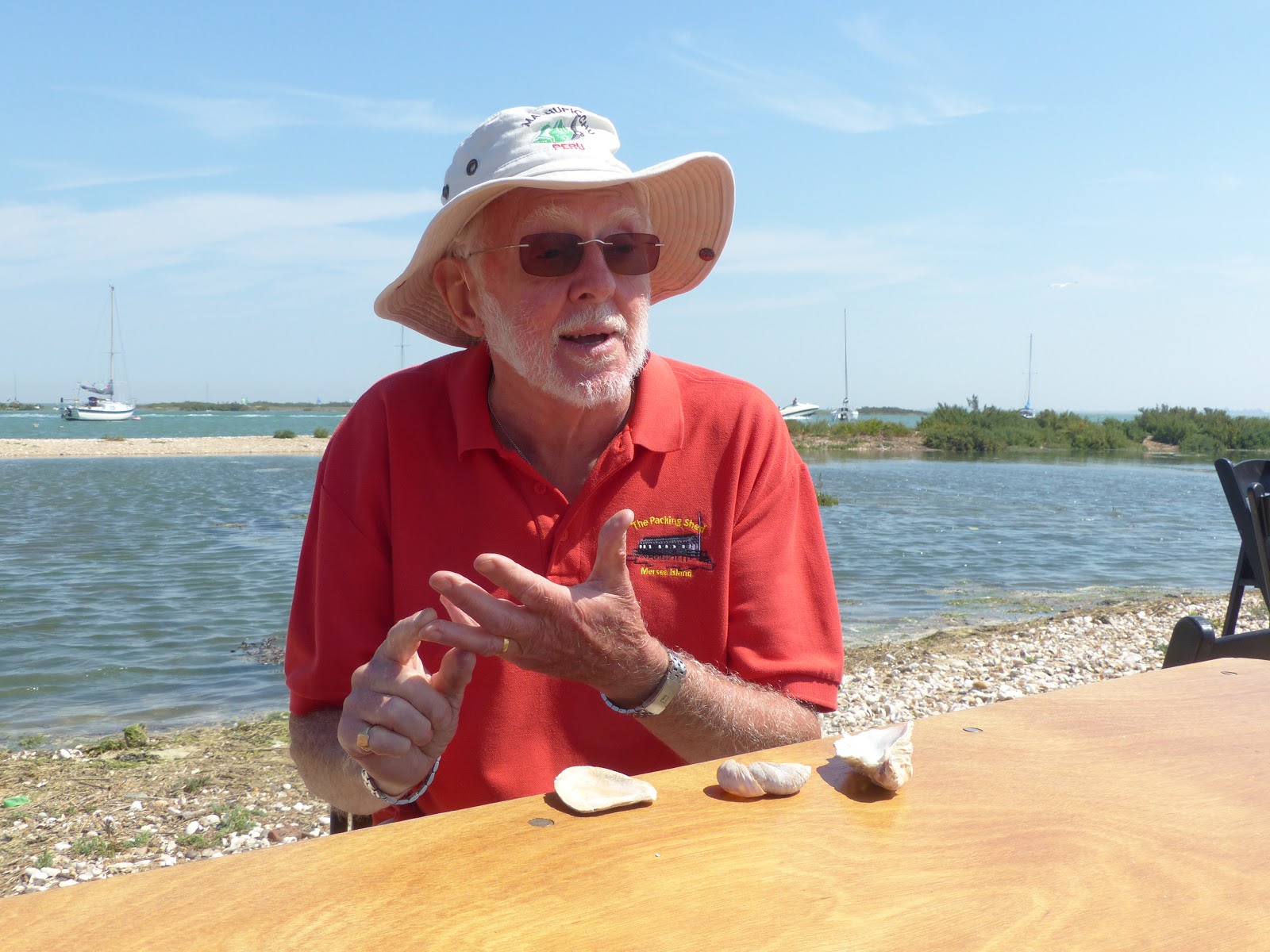
This gentleman joined us at the table and told us about the history of The Packing Shed. He bought examples of oyster shells and told how the local oysters were devastated by disease on several occasions. The last survivors were sadly lost in the 1963 winter when this area of the coast froze over. Stocks were replenished from other sources and they have gradually re-established. Meantime it was suggested that oysters from Portugal was also introduced. These are a much larger variety and fairly resistant to disease, and so far stocks are doing well and traditional oyster fishing continues. We also learnt that the 'slipper limpet' was bought into local waters by US ships during WWII. Because these encrusted the bottom of the ship and slowed them down, they dragged them off using chains. The limpets have since grown in huge numbers, and frequently seen around the coast.  

Meanwhile the tide continued to go out, and the spit got smaller and smaller.


We could still walk around the last narrow stretch, being careful of the resident birds.


Maybe the time passed quickly because we enjoyed learning about the island and exploring, and it didn't seem long before we spotted the tell tale sign of the tide turning. We saw Samphire growing in abundance, a delicacy more seen in restaurants than in shops. 


The stretch of shingle stretched and stretched with the outgoing tide until we could walk right out. 


And once again island revealed the oyster filter beds, and The Packing Shed said goodbye to its visitors until next time. 


Something I learnt during my visit was the importance of this spit of land and the two small islands that lie next to it. Together these protect the main harbour and fishing grounds of East Mersea, reducing the silt and coastal erosion. I've read about this is the book 'How to Read Water' but it never occurred to me that these small islands so far from shore could have such an impact. So, granite and sea shells have been added to raise the height and stabilise The Packing Shed island, and more is planned in the near future. It was also interesting to learn that the shells come from local waters to maintain ecology, and that the granite is also carefully chosen too. It was a wonderful visit and the weather was just perfect with blue skies and a cooling breeze. I am already looking forward to my next visit!

This post is part of a project in an attempt to learn 'How to Read Water'. It includes daily observations and visits to local rivers over a 30 day period. You can read more about it here. 

Monday, 16 July 2018

How to read water - A visit marked with sadness

My second visit to the river was marked with sadness. As I took my photos I noticed a swan on the tide line, separate from all the others. A passing dog walker expressed her concern too, and a man  went to look at the swan and told us it had been shot. Apparently there was a hole in it's back, and it's prospects didn't look good. 


After much effort I managed to contact the RSPCA (Royal Society for the Protection of Animals) who luckily have a wildlife welfare team. I gave the location and was asked if I could stay with the swan or let them know if anything changes. Some time later I saw a voicemail, telling me an officer was on his way but would not be there until after 10pm. I had not gone prepared for a long stay. The evening had turned cool by now and my daughter had come down with coffee and warmer clothing for me, but by 9pm I decided I couldn't wait any longer. I needed to eat and still had things to attend to, so I phoned the RSPCA back, gave them precise location and update and let them know there was no change in the swans condition. By now there was no dog walkers or other people walking along the river so I was less concerned about the swan being disturbed. I had done all I could as there were no local vets open this time of evening, and I could only trust that the RSPCA would attend as promised.

The next evening I arrived at the river and saw the swan was gone. But after taking photos of the state of river, I started to walk along the sea wall and that's when I saw the swan. 

Maybe the officer had put the swan out of it's misery and left the body there; or maybe for some reason they did not come and the swan died of it's own accord. Either way the tide would have been high on two occasions since my visit, so I'm guessing the water carried it further along. Clearly it has been food for birds or maybe foxes, and it was sad to see the fate of this beautiful creature. When choosing to 'read water' I hadn't anticipated this might be part of my experience. But realistically, it is part of life and it was heartening to see the concern of other people who stopped to talk that first evening.


I continued my walk along the sea wall as planned and this time I noticed other things:

A jelly fish. 

An oyster shell. I now know this variety originates from Portugal. More about that in my next post.

And I have been surprised at how much the tide changes day by day. It's one thing knowing it from a tide time-table, and another to witness and pay attention. I am trying to visit at roughly the same time and today, instead of a trickle, the water was still deep enough for this red boat to swing gently on it's anchor. 

These shallow curves of waterflow are also teaching me about the depth and flow. I wonder what other things I will be discovering, and hopefully there will be no more injured birds or animals. 
Related Posts Plugin for WordPress, Blogger...